News
‘Treatment is More Than Reducing Pain Intensity’: Dr Michael Überall on the Future of Pain Medicine
Pain specialist Dr Michael Überall discusses cannabinoid-based medicines, opioids, and what meaningful improvement looks like for patients.
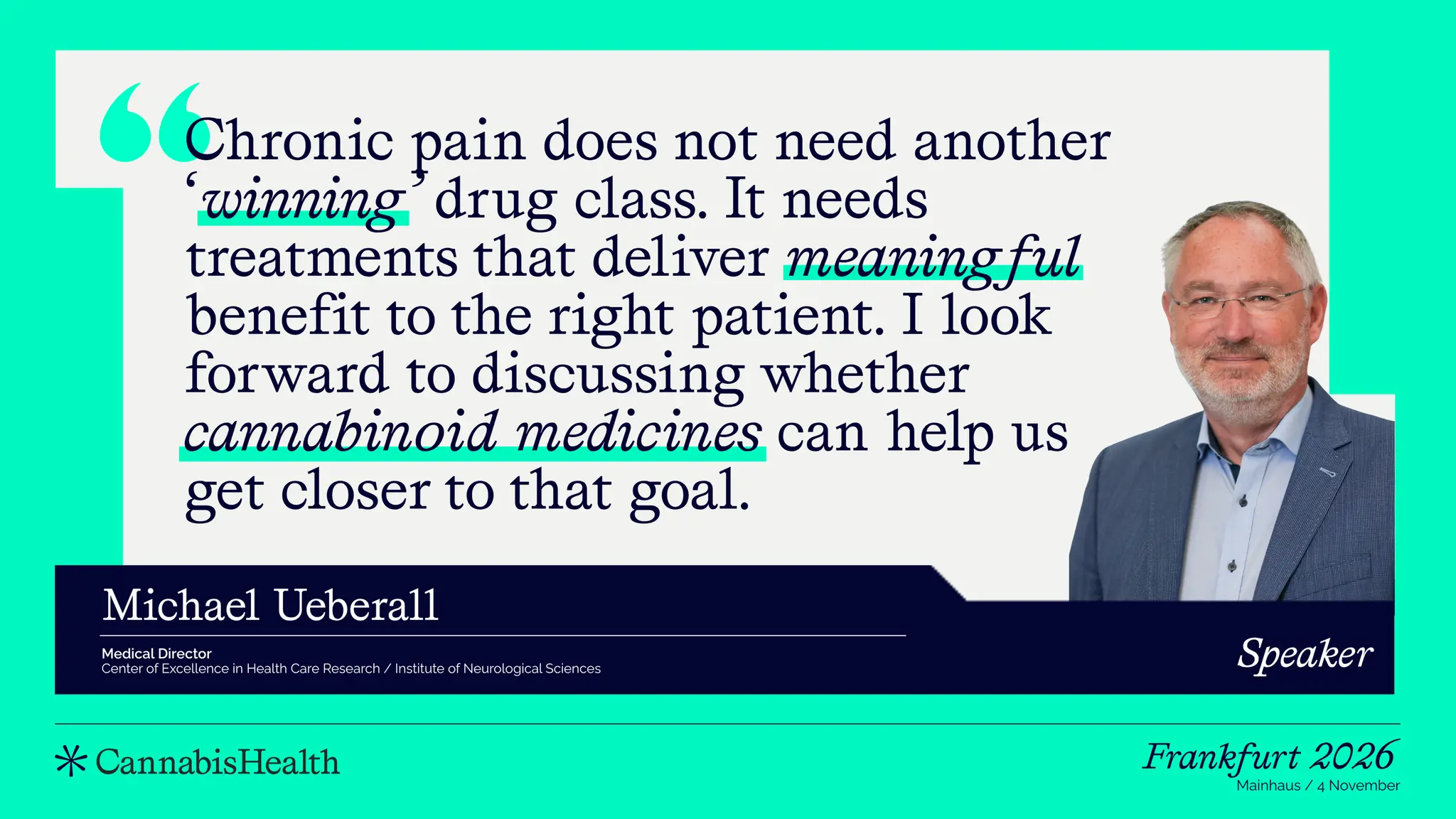
Ahead of next week’s Cannabis Health Symposium in Frankfurt, a leading German pain specialist discusses the latest evidence for cannabis-based medicines, how they compare with opioids and what recent clinical trials mean for patients with chronic pain.
Dr Michael Überall, medical director at the private Institute of Neurological Sciences and the German Pain Association’s Centre of Excellence for Health Care Research, will join a panel exploring the role of cannabinoids and opioids in pain management.
In a Q&A with Cannabis Health, he explains why findings from one cannabis medicine cannot be applied to others, where clinical experience can be misleading, and why successful pain treatment goes beyond reducing pain scores.
Cannabis Health: Which types of pain do we have the strongest evidence for treating with cannabis medicines?
Dr Michael Überall: Historically, most research on cannabis-based medicines has focused on chronic neuropathic pain. However, we need to distinguish between the amount of research conducted and the actual strength of the evidence. The latest systematic reviews still identify considerable uncertainty, particularly because previous studies have investigated very different products, doses, formulations and patient populations.
The recent VER-01 development programme is particularly interesting because it moves beyond this heterogeneous evidence base. We now have large, controlled clinical trials involving a standardised cannabinoid medicine in patients with chronic low back pain, including those with a neuropathic component.
This is an important step forward: rather than discussing whether “cannabis” works for pain in general, we can finally discuss the clinical efficacy of a defined medicine in a defined patient population.
CH: What do the recent VER-01 back pain trials tell us? How much difference did the treatment make, and what were the drawbacks?
MU: The recent VER-01 trials represent a major step forward in cannabinoid-based pain medicine. The first placebo-controlled Phase III trial showed significant analgesic efficacy, along with meaningful improvements in neuropathic symptoms, physical function, and sleep quality. Importantly, these benefits were particularly pronounced in patients with a neuropathic pain component.
The second Phase III trial went one step further by directly comparing VER-01 with established opioid analgesics. Over six months of treatment, VER-01 demonstrated statistically better/stronger pain reduction and improvements in sleep, while reducing the risk of constipation by approximately 75%.
These findings are particularly important because they challenge the traditional assumption that escalating to opioids is necessarily the next pharmacological step when non-opioid analgesics provide insufficient relief.
Regarding tolerability, the trials also taught us an important lesson: most adverse effects occurred during the initial dose-titration phase, were predominantly mild to moderate, and declined substantially during continued treatment.
This highlights the importance of an individualised dosing strategy: ‘start low, go slow, and stay low’. In clinical practice, the objective should not be to reach the highest possible dose as quickly as possible, but to identify the lowest effective and best-tolerated dose for each patient. Although adverse effects cannot be completely avoided, careful dose titration may substantially improve tolerability.
Taken together, these studies suggest that VER-01 is not simply another treatment option for patients who have exhausted conventional therapies. It offers an evidence-based opportunity to reconsider the sequence of pharmacological treatment in chronic low back pain, particularly before initiating long-term opioid therapy.
CH: How do cannabis medicines compare with opioids in terms of pain relief, side effects and everyday life?
MU: For patients with chronic pain, effective treatment means much more than simply reducing pain intensity. It means sleeping better, maintaining physical activity, preserving independence and being able to participate in everyday life.
This is precisely why the recent head-to-head comparison between VER-01 and opioid analgesics is so important.
Over six months, VER-01 demonstrated statistically stronger pain relief in longitudinal analyses, accompanied by better sleep outcomes and a substantially lower risk of constipation. These findings challenge the traditional assumption that opioids necessarily represent the more effective pharmacological option for patients with persistent chronic low back pain.
Of course, cannabinoid medicines have their own adverse-effect profile. However, the VER-01 studies suggest that many of these effects are concentrated in the initial titration phase and decline considerably during continued treatment. This underlines the importance of an individualized approach.
Opioids, by contrast, present well-recognised challenges during long-term treatment, including gastrointestinal adverse effects, tolerance, physical dependence and potentially problematic patterns of use.
From a clinical perspective, the key question is therefore not simply which medicine provides the greatest reduction in pain intensity, but which treatment offers the most favorable balance between analgesic efficacy, tolerability and improvements in everyday functioning.
For appropriately selected patients, the emerging evidence suggests that VER-01 may offer advantages over opioid therapy across several clinically relevant outcomes.
This leads to a fundamental change in clinical practice. With the approval of Exilby in Germany, an evidence-based cannabinoid medicine can now be prescribed to adults with chronic low back pain and a radicular neuropathic component following insufficient efficacy or intolerance of non-opioid analgesics — without requiring prior opioid treatment. This is no longer merely a theoretical option, but an approved therapeutic alternative that allows physicians to reconsider the traditional escalation toward opioids, supported by clinical evidence suggesting a more favorable benefit–risk profile for VER-01 in the studied population.
CH: Can findings about VER-01 tell us anything about other cannabis products, or are they too different?
MU: This is one of the most important questions in cannabinoid medicine. Cannabis is not a single pharmacological substance. Different products contain different concentrations and combinations of cannabinoids and other plant constituents. Their pharmacokinetics, bioavailability and clinical effects can vary substantially.
VER-01 is a standardised, pharmaceutical-grade cannabis extract investigated in a structured clinical development programme. Its results can therefore not be transferred to cannabis flowers, magistral preparations, CBD products or other cannabinoid formulations. At the same time, these trials demonstrate that cannabinoid-based medicines can be developed and evaluated according to the same scientific and regulatory standards as conventional analgesics.
For me, that is one of the most important achievements: the transition from a generalised debate about medical cannabis to evidence-based cannabinoid pharmacotherapy.
CH: What have you learned from treating patients that the trials haven’t captured? Where can clinical experience be misleading?
MU: One of the most important lessons from treating patients with chronic pain is that pain intensity alone tells us surprisingly little about the actual burden of the disease. Two patients reporting the same pain intensity may differ enormously in their physical limitations, sleep disturbances, emotional distress, social participation, and ability to manage everyday life.
What matters to patients is not necessarily achieving the lowest possible score on a pain scale. It is regaining control over their lives, being able to sleep, move, work and participate in activities that give their lives meaning.
Another important lesson is that there is no universal optimal dose. Particularly with cannabinoid medicines, individual differences in sensitivity, tolerability and therapeutic response can be substantial. This is why I believe that “start low, go slow, and stay low” is not merely a dosing recommendation, but an essential principle of individualized treatment.
However, clinical experience has its limitations. We tend to remember remarkable treatment successes more vividly than failures. Patients who benefit often remain in treatment, while those who discontinue because of insufficient efficacy or adverse effects may disappear from our clinical perspective.
This is where systematic real-world research becomes essential. Randomized controlled trials tell us whether a treatment can work under defined conditions. Real-world evidence helps us understand how it performs in heterogeneous patient populations, how treatment benefits evolve over time, and whether patients can maintain therapy in everyday clinical practice.
Neither approach can replace the other. We need both to understand not only whether a medicine reduces pain, but whether it provides meaningful and sustainable benefits for the people receiving it.
Ultimately, successful pain treatment is not about achieving the best possible pain score. It is about helping patients achieve the best possible life despite their pain.
CH: What would you like doctors to take away from your session in Frankfurt?
MU: I would like physicians to reconsider not only where cannabinoid-based medicines fit into the treatment of chronic pain, but also what we should ultimately expect from successful pain management. For many years, the discussion about medical cannabis has been dominated by two opposing perspectives: cannabinoids as a last resort when everything else has failed, or cannabinoids as a universal alternative to conventional analgesics. Neither position is scientifically satisfactory.
The recent approval of Exilby represents an important step forward. For adults with chronic low back pain and a radicular neuropathic component who have not responded adequately to, or cannot tolerate, non-opioid analgesics, we now have an approved cannabinoid medicine supported by a comprehensive clinical development programme.
Importantly, the clinical evidence goes beyond demonstrating efficacy against placebo. In a direct comparison with opioid analgesics, VER-01 demonstrated statistically superior pain relief in longitudinal analyses, improved sleep outcomes and substantially better gastrointestinal tolerability.
These findings provide a compelling rationale for reconsidering the traditional treatment pathway. Rather than reserving cannabinoid medicines for patients who have already failed opioid treatment, we should consider an evidence-based cannabinoid option before escalating to opioids in appropriately selected patients.
But there is another lesson I would like physicians to take home. Chronic pain is not simply a symptom measured on a numerical rating scale. It is a complex condition that affects almost every aspect of a person’s life. Our therapeutic decisions must therefore consider not only analgesic efficacy, but also physical functioning, sleep, quality of life, treatment tolerability, and the ability to maintain benefits over time.
This is why I believe that the future of pain medicine lies not in replacing one class of analgesics with another, but in using the right treatment for the right patient at the right time.
Ultimately, successful pain treatment is not about achieving the best possible pain score. It is about helping patients achieve the best possible life despite their pain. And perhaps this is the most important message of my presentation. The real breakthrough is not simply that we have a new cannabinoid medicine. It is that, now equipped with clinical evidence of a more favorable benefit–risk profile for VER-01 compared with opioids, we have both the opportunity and the responsibility to rethink when, why and for whom opioid treatment should be initiated.
Hear more from Dr Michael Überall at the Cannabis Health Symposium, Mainhaus, Frankfurt, on 4 November. View the programme and book tickets here.
Get the weekly briefing
A round-up of the latest science, regulation and developments across the UK and Europe — in your inbox every week.