News
“We Need Studies Designed For Women”: Medical Cannabis Q&A with Dr Shabnam Sarshar
Dr Shabnam Sarshar discusses the growing demand for medical cannabis among women, the gaps in clinical evidence, and why research is urgently needed.
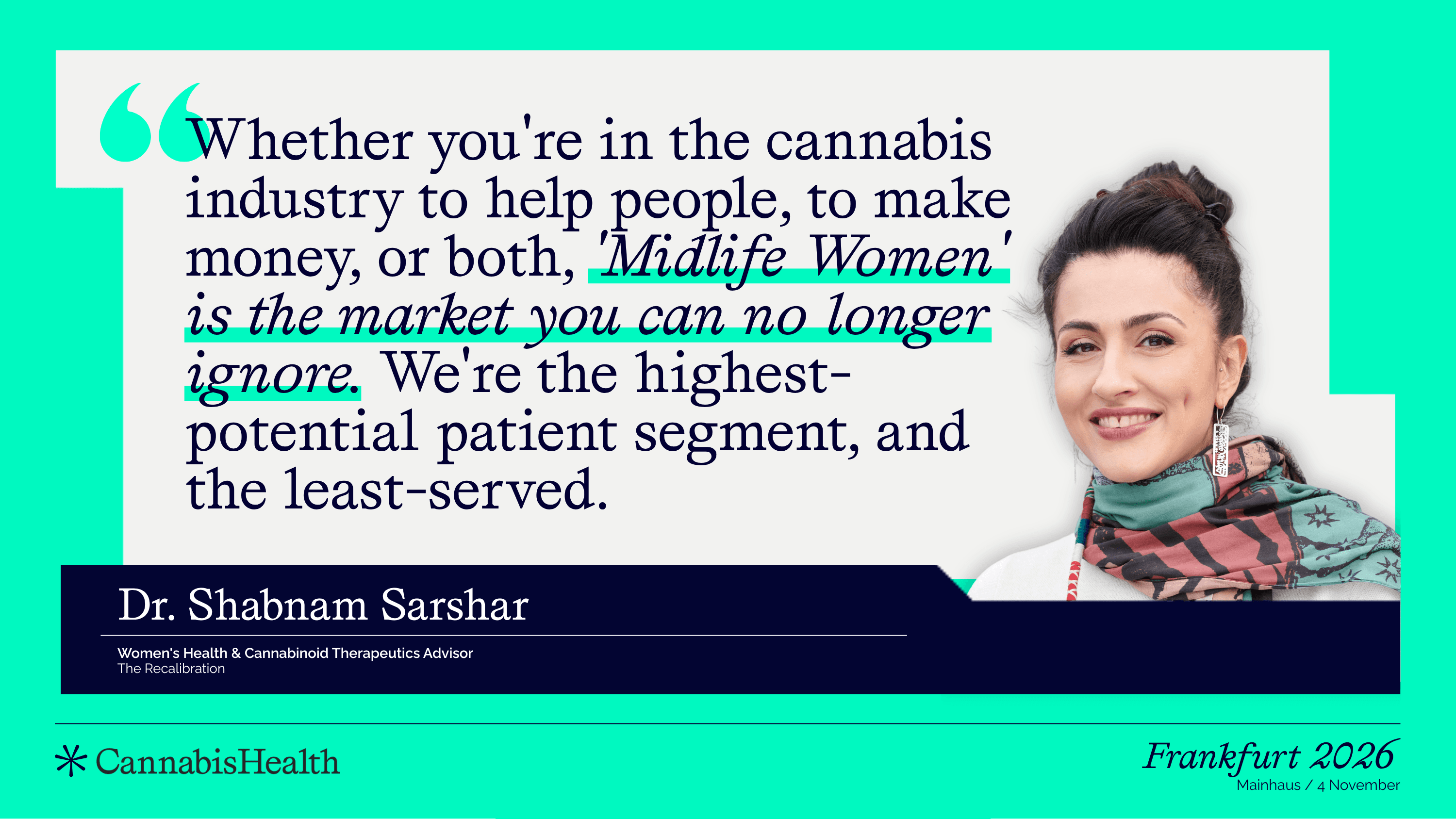
Ahead of the Cannabis Health Symposium Frankfurt next month, Dr Shabnam Sarshar discusses the growing demand for medical cannabis among women, the gaps in clinical evidence, and why female-specific research is urgently needed.
In Germany, around two million women are living with endometriosis, with diagnosis often taking eight to ten years.
While hormonal therapies and surgery remain the mainstays of treatment, many patients continue to experience debilitating symptoms, prompting some to explore cannabis as an alternative or complementary approach.
Patient-reported data suggest potential benefits, particularly for pain and sleep, but robust clinical trials are lacking. Significant questions also remain around how hormonal fluctuations and different stages of women’s lives may influence cannabinoid response.
At Cannabis Health Symposium Frankfurt, Dr Shabnam Sarshar will explore these issues in her session, Endometriosis and Beyond: Medical Cannabis in Women’s Health.
A phytopharmacist and women’s health strategist specialising in cannabinoid science and female-specific physiology, Dr Sarshar holds a PhD in Pharmaceutical Biology and Phytochemistry and has more than a decade of experience across pharmaceutical research, medical advisory and women’s health entrepreneurship.
She is also the founder of The Recalibration, a platform focused on reframing midlife as a period of biological recalibration rather than decline.
Ahead of the symposium, Cannabis Health spoke to Dr Sarshar about the evidence behind cannabis use in women’s health, the barriers to accessing treatment in Germany, and what clinicians need to know. Her responses have been lightly edited for clarity and editorial style.
Cannabis Health: What are the most common conditions women are seeking cannabis-based medicines for, and how well does the current clinical evidence support their use?
Dr Shabnam Sarshar: Chronic pain. Data from Germany show women make up the majority of patients treated with reimbursed cannabinoid medicines for non-cancer pain (66.7% in BARMER data and 59.8% in BfArM’s accompanying survey). The bitter fact is that although women are officially the majority of reimbursed patients, no German study breaks this down by women’s health condition — except endometriosis.
CH: What is the current state of research into the use of medical cannabis in women’s health conditions in Germany?
DSS: A 2022 DACH-region survey found 17% of a relevant subgroup self-managing endometriosis with cannabis, reporting 91% better sleep, 90% less menstrual pain, and roughly 90% reduced use of other pain medication.
That’s compelling patient-reported signal, not clinical-trial evidence — it’s a self-selected, cross-sectional survey, and Germany has zero comparable data for menopause, PMDD, or fibromyalgia. But the pattern isn’t unique to Germany.
Internationally, no randomised controlled trials exist for cannabinoids in menopause either, despite many cannabis-using midlife women reporting benefit for sleep, mood, and pain — evidence I’d grade emerging at best.
The fact is that patient demand and real-world evidence are already ahead of clinical guidelines in several women’s-health indications.
CH: How does this affect our understanding of cannabinoid medicine in this area, and what are the most important gaps still to fill?
DSS: The gap in cannabinoid medicine is not simply that too few women have been included in studies. It is that research has rarely been designed around women’s biology.
Cannabis research was constrained for decades by prohibition and Schedule I classification in the United States. At the same time, 1977 FDA guidance recommended excluding women of childbearing potential from Phase I and early Phase II drug trials. These were different policies, but together they narrowed the evidence base precisely where women’s health and cannabinoid science overlap.
Today, women with endometriosis, menstrual pain, PMDD, pelvic pain, perimenopausal symptoms, and menopause-related sleep or mood changes are often offered cannabinoid treatments based on broad evidence for “pain,” “anxiety,” or “sleep.” But these are not interchangeable conditions. Their symptoms, hormonal context, comorbidities, and treatment goals differ—and so may their response to a cannabinoid intervention.
The endocannabinoid system (ECS) is itself hormone-responsive. Oestrogen can influence FAAH, the enzyme that breaks down anandamide, and anandamide levels change across the menstrual cycle. Yet we have very limited human data on whether THC and CBD are absorbed, metabolised, tolerated, or need to be dosed differently during the menstrual cycle, perimenopause, or after menopause. In other words, we are using interventions that affect a hormone-sensitive system without enough information about how hormonal transition changes the response.
What we need now is not simply more women counted in trials. We need studies deliberately designed for women.
CH: What are the main barriers women face in accessing medical cannabis in Germany, and has CanG meaningfully changed that picture?
DSS: CanG removed a real bureaucratic barrier — no more BtM prescriptions, far easier private and telemedicine access. That’s genuine progress. CanG partially solved the access problem, but not the knowledge problem. In my conversations with gynaecologists and women seeking support, I see three main barriers.
First, many clinicians have had little training in the endocannabinoid system or cannabinoid pharmacology. They are understandably cautious because they have little to no knowledge about the ECS and cannabinoid based interventions, and high-quality evidence for many women-specific conditions is still limited.
Second, cannabis-naïve women often equate medical cannabis with getting high or smoking. Many do not know that treatment may involve non-inhaled formats, such as oral preparations or topical and local products. Basic questions — such as whether a CBD cream causes intoxication or affects driving — show how large the information gap still is.
Third, women who are ready to explore treatment often struggle to find a clinician who can provide a full consultation, not just a prescription. Cost also remains a major barrier, particularly for non-inhaled products that may be more acceptable or appropriate for some women but are often paid for out of pocket.
CanG has made the legal and administrative route easier. But it has not yet solved the clinical education, patient-information, or affordability gaps that determine whether women can actually access safe, appropriate care.
CH: How do you approach patient counselling around cannabis for conditions like endometriosis or PMDD, where the evidence base is still developing?
DSS: In conditions where the evidence is still developing, I begin with education, not with a product recommendation. I use accessible materials to explain the ECS, its role in pain, stress, sleep, immune signalling, and reproductive health, and why it may be relevant across the female life course.
Many women still associate cannabis only with smoking or getting high. So I explain that cannabinoid-based medicines are way more sophisticated than that: products differ in THC and CBD content, formulation, route of administration, onset and duration of effect, potential impairment, and risks.
I am also very clear about the evidence. I distinguish between what is biologically plausible, what women report in real-world use, and what has actually been demonstrated in clinical trials. We then discuss what the individual woman hopes to improve — such as pain, sleep, mood, or cycle-related symptoms — and what realistic treatment goals would look like.
The aim is never to persuade someone to use cannabis. It is to help her make an informed, non-judgemental decision and feel prepared to open a meaningful conversation with her doctor.
CH: What do you most want clinicians and healthcare professionals attending the Frankfurt Symposium to take away from your session?
DSS: I want clinicians to ask a different question. Not only whether cannabis works for endometriosis, fibromyalgia, or menopause, but how might this woman’s endocannabinoid system be interacting with her hormones, pain, sleep, stress, and stage of life?
Oestrogen, FAAH — the enzyme that breaks down anandamide — and cannabinoid signalling are interconnected. This does not yet give us a diagnostic test or a universal treatment answer, but it offers a more connected biological framework for conditions we often manage separately.
Meanwhile, women are already using cannabinoids for symptom relief. That is not proof of efficacy, nor a reason to prescribe uncritically. It is a reason for clinicians to understand the science well enough to have an informed, non-judgemental conversation — rather than leaving women to navigate it alone.
Secure your place
Dr Shabnam Sarshar will take part in the session Endometriosis and Beyond: Medical Cannabis in Women’s Health at the Cannabis Health Symposium Frankfurt, exploring the role of the endocannabinoid system in women’s health, the limitations of current evidence, and the need for more targeted research and clinical education.
Healthcare professionals can also apply for a concession ticket.
Get the weekly briefing
A round-up of the latest science, regulation and developments across the UK and Europe — in your inbox every week.