News
‘Patient First, Suspect Second’: Richard List on Medical Cannabis and Policing in the UK
Ahead of the Cannabis Health London Symposium next week, senior police drugs adviser Richard List warns of gaps in UK police knowledge of medical cannabis, while welcoming growing engagement and outlining plans for new driving guidance
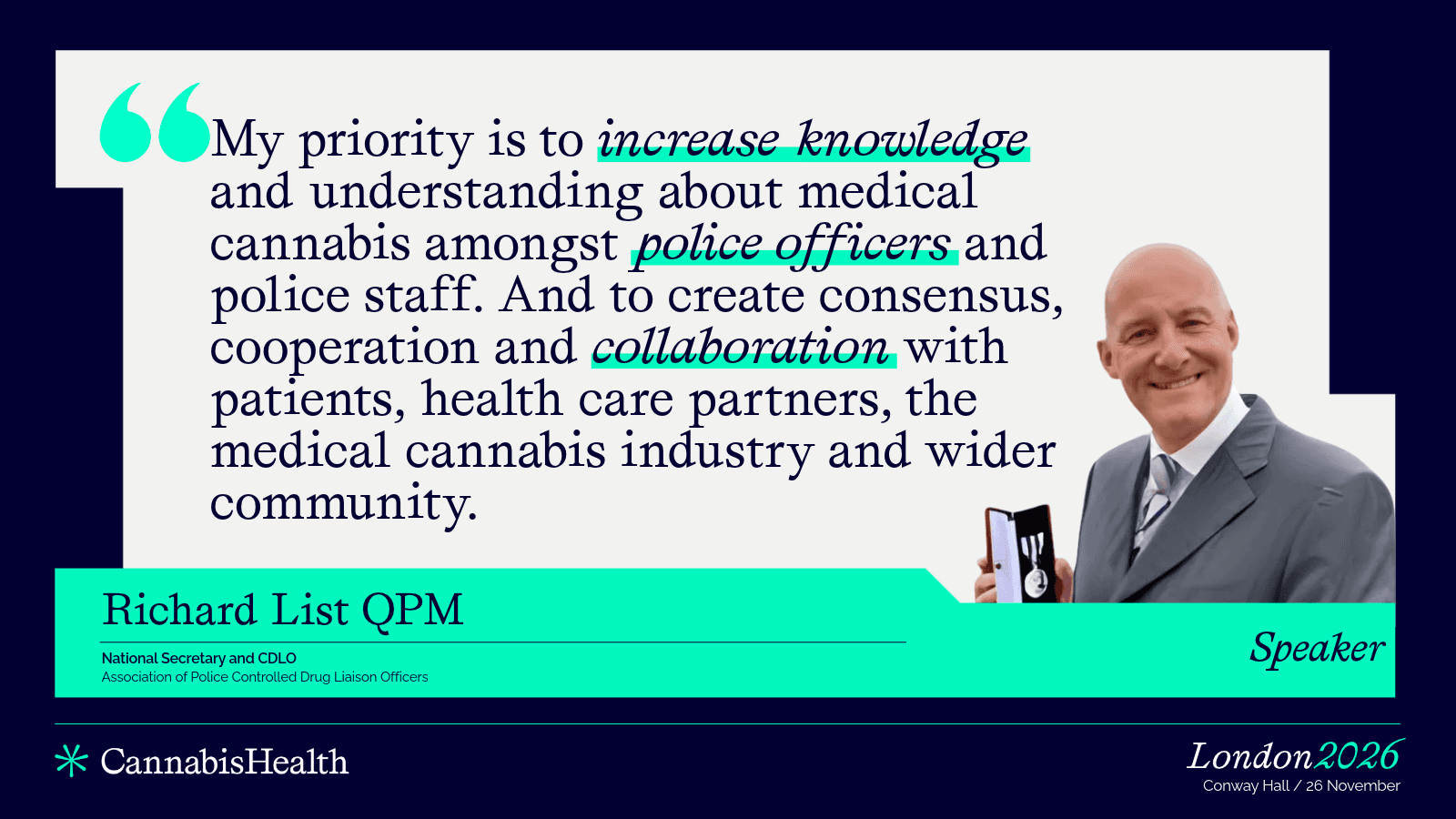
A lack of knowledge and understanding among police officers continues to cause problems for medical cannabis patients, a senior police drugs adviser has warned.
Richard List QPM, National Secretary of the Association of Police Controlled Drug Liaison Officers (APCDLO), said he still encounters officers who admit they “didn’t know it was legal” – despite medical cannabis having been available on prescription since 2018.
He warned that a lack of knowledge and understanding meant some officers “lack confidence”, which could lead them to take unnecessary action against patients with legal prescriptions.
Despite this, List said there was “great interest” among police officers in learning more about medical cannabis, with many recognising the need to improve their understanding.
Speaking to Cannabis Health ahead of next week’s London Symposium, he described police knowledge as “patchy”, but said most officers he engaged with were keen to learn more.
A former Detective Chief Superintendent who served 30 years in policing, including leading the Thames Valley Police Drug Squad, List authored the first national police guidance on medical cannabis, published in October 2025.
The guidance, Patient First, Suspect Second, was approved by the National Police Chiefs’ Council (NPCC) and aims to help officers understand the law and deal appropriately with patients who have legal prescriptions.
A second edition is being developed, which will include guidance on driving.
List is also helping organise a national online event for police officers in February, aimed at improving their understanding of medical cannabis, including how to verify patients’ prescriptions.
He will discuss the practical implications of the law and the responsibilities of patients, clinicians and police officers at the Cannabis Health London Symposium on Thursday 26 November.
The CPD-certified event is returning to Conway Hall next week, bringing together healthcare professionals, researchers, industry leaders and patient advocates to discuss the challenges facing the medical cannabis sector.
Taking place eight years after medical cannabis was legalised on prescription in the UK, the symposium will cover research, regulation, clinical practice, patient safety and access.
Following last year’s London Symposium and the Frankfurt event earlier this month, the event aims to help healthcare professionals better understand the evidence and practical challenges around prescribing cannabis-based medicines.
List’s session, Medical cannabis police guidance: understanding rights and responsibilities, will take place at 11.30am.
Ahead of the event, Cannabis Health spoke to him about patients’ rights, what should happen during police encounters and where further improvements are needed.
What do police officers still tend to misunderstand about prescribed medical cannabis?
“The main question really is generally trying to raise knowledge and understanding amongst police officers. Currently things can be patchy.
“There are some very good examples of some pretty well-informed officers, but there are a lot of examples of officers who don’t really understand the basics.
“For example, I still see situations where officers say, ‘I didn’t know this was legal.’
“There is some academic research done by Liverpool John Moores University, although that is quite a small cohort, and that really does support the fact that police officers’ levels of knowledge and understanding are pretty low.
“One of the key things for me here is that because officers don’t always have the knowledge and understanding, they lack confidence, and because they lack confidence, that can push them into making probably what one could describe as being risk-averse decisions, which can be problematic for patients.
“The whole purpose of doing all this work, certainly from a police perspective, is really to raise levels of knowledge and understanding.
“Those levels of knowledge and understanding are low across the public sector, to be frank, not just the police, but also the private sector.”
Are some police forces better informed than others?
“Generally no.”
“This is a national issue across the whole of the 43 police forces.
“That’s one of the reasons why we are holding this national police online event in February.
“It’s going to teach officers or inform officers about the basics. What is medical cannabis? How can you verify a patient? These types of things.
“We’ll record that, and we do hope that’s going to make a significant difference.
“What I think is worth pointing out is that levels of knowledge and understanding are low, but there’s great interest in this amongst police officers.
“When you engage with them, speak to them, they are interested, and most of them do want to learn more and actually see this as an important issue.
“I’ve had a lot of people contact me saying we’re seeing more and more medical cannabis on the streets, we’re seeing more and more patients raising these issues, and we’d like to know a lot more about this because at the moment our knowledge is lacking and we’re not providing the service that we want to provide.
“I see that as a very positive thing.”
If an officer stops someone carrying their prescribed medical cannabis, what should happen next?
“I first wrote the guidance, and that came out in October 2025. That had been approved by the National Police Chiefs’ Council.
“What that guidance is really saying is the phrase I always use: patient first, suspect second.
“That is asking police officers, when they come across a medical cannabis patient, whatever the encounter might be, to treat that patient as a patient.
“If they say they’re a patient, treat them as a medical cannabis patient first until proven otherwise.
“What we don’t want is officers treating them as suspects first.”
What paperwork is useful for patients to carry, and what are they actually required to have?
“The first thing is really how do you actually verify whether a person is a lawful medical cannabis patient, and that can be tricky at times.
“Fundamentally, what we want officers looking for is the prescription. That can be digital or paper.
“The second thing is, have they got a letter from their specialist prescribing doctor? That’s obviously another way of verifying it as well.
“The other way, which isn’t quite as good, is the actual packaging itself. The packaging should have details on it, including details of the individual.
“There is one company called Releaf, and they actually produce a Releaf card. That card is a legitimate form of showing that someone has got a medical cannabis prescription.
“Personally, I think the Releaf card is very useful. Although that’s not included in the first edition of the guidance, it is going to be included in the second edition.
“The Relief card is not to be confused with the CanCard, which is something completely different. CanCard is not seen as an approved form of verification by the police service anymore, and it does not show lawful possession of medical cannabis.
“In a nutshell, your prescription, your letter if you’ve got it, the packaging, and if you belong to a Releaf clinic, the Releaf card. They are the four pieces of verification that the police officer will use.
“It doesn’t mean you’ve got to have all of those, of course. One of those should suffice, but you’ve also really got to have some sort of ID as well.
“We’re not saying that in law the person actually has to produce those documents. In law, they don’t have to produce those documents, because they are related to medical confidentiality.
“But we have agreed, and this has been supported by the Department of Health and Social Care, by a lot of medical cannabis clinics and healthcare practitioners, that the advice is you really do need to carry some ID with this medicine.
“What I want is a consensual arrangement where police officers have knowledge, there’s consensus from the patients, and it’s just a quick exchange of ‘This is my medicine, these are the details.’
“I do understand that a number of people say that’s a bit unfair, that wouldn’t apply to any other medicine. I accept that, but there isn’t really any other medicine like medical cannabis, whether we like it or not.
“What I’m trying to do is reach a balance that reduces any unnecessary hindrance caused to patients but ensures the law is upheld and implemented fairly.”
For more information on prescription verification, read Cannabis Health’s explainer on UK medical cannabis cards.
What is happening with the new guidance on medical cannabis and driving?
“The second edition of the guidance will feature driving. The first edition just featured very basic advice about impairment.
“This is one of the biggest problems that cannabis patients face. I know it worries them entirely.
“The law is quite confused and quite complicated because you’ve got different pieces of legislation.
“You’ve got Section 4 of the Road Traffic Act 1988 that talks about impairment. You have Section 5A, which came out in 2015, and then after that in 2018 medical cannabis was legalised.
“One of the problems with Section 5A is that it says if you have a certain amount of THC in your body, and that amount is two micrograms per litre of blood, and you’re in excess of that, then you’re over the limit.
“The problem is that most medical cannabis patients taking that medicine exactly as prescribed by their doctor will exceed that limit because of the fatty nature of cannabis and the way that it remains in the body.
“At the present time, police officers have a range of lawful options.
“This presents a quandary for the officer. Do they accept you’re a medical cannabis patient? Do they arrest you? Do they take you to the police station? Do they take blood from you? Does the CPS decide to charge you? Do you end up in court?
“All these incidents have happened, and so there isn’t really any consistency. The approach is very inconsistent at the moment, and there is quite a bit of disagreement in the police service.”
What needs to happen before the new driving guidance can be published?
“The two key points here are that if you’re a medical cannabis patient, you should not be driving if in any way you feel impaired.
“If you feel a bit dizzy, a bit of a headache, particularly if you’ve just started to take medical cannabis or your THC has been increased, if there is any concern, you should not be driving until you feel sound to drive.
“The second point is that we have reached agreement with the NPCC Roads Policing portfolio.
“We have prepared a briefing paper which outlines all these issues, and that is now being sent for specialist legal advice.
“This legal advice will then be used to prepare the definitive UK Guidance on medical cannabis and driving.
“This will take some time but the compass point is heading in the right direction, but there’s still quite a long way to go.
“What we really want officers to be is informed, knowledgeable and using common sense, as opposed to an automatic implementation of the law. This is an important balance and officers need to be supported with effective and clear guidance.”
What’s the main thing you’d like people to take away from your talk at the London symposium?
“My simple view would be: we just need to keep talking, we need to keep engaging, and we need to keep listening.
“Communication and listening are critical in this area.”
Cannabis Health Symposium London 2026: tickets and essential information
The Cannabis Health Symposium takes place on Thursday 26 November 2026, from 8:30 am to 5 pm, at Conway Hall, 25 Red Lion Square, London WC1R 4RL.
The event is certified by The CPD Certification Service and is open to healthcare professionals, researchers, industry representatives, and patient advocates.
Final Release tickets are priced at £284.09, with concession tickets available for healthcare professionals at £100, subject to verification.
All tickets include 12 months’ free membership of the Medical Cannabis Clinicians Society (MCCS), worth up to £120.
With just one week to go, healthcare professionals and other interested attendees are encouraged to secure their place.
View the full programme and book your ticket for the Cannabis Health Symposium London 2026 here.
Get the weekly briefing
A round-up of the latest science, regulation and developments across the UK and Europe — in your inbox every week.