News
Senior Police Drugs Advisor to Present Medical Cannabis Guidance at London Symposium
Officials are working on more definitive guidelines around driving and medical cannabis ahead of Cannabis Health Symposium later this year.
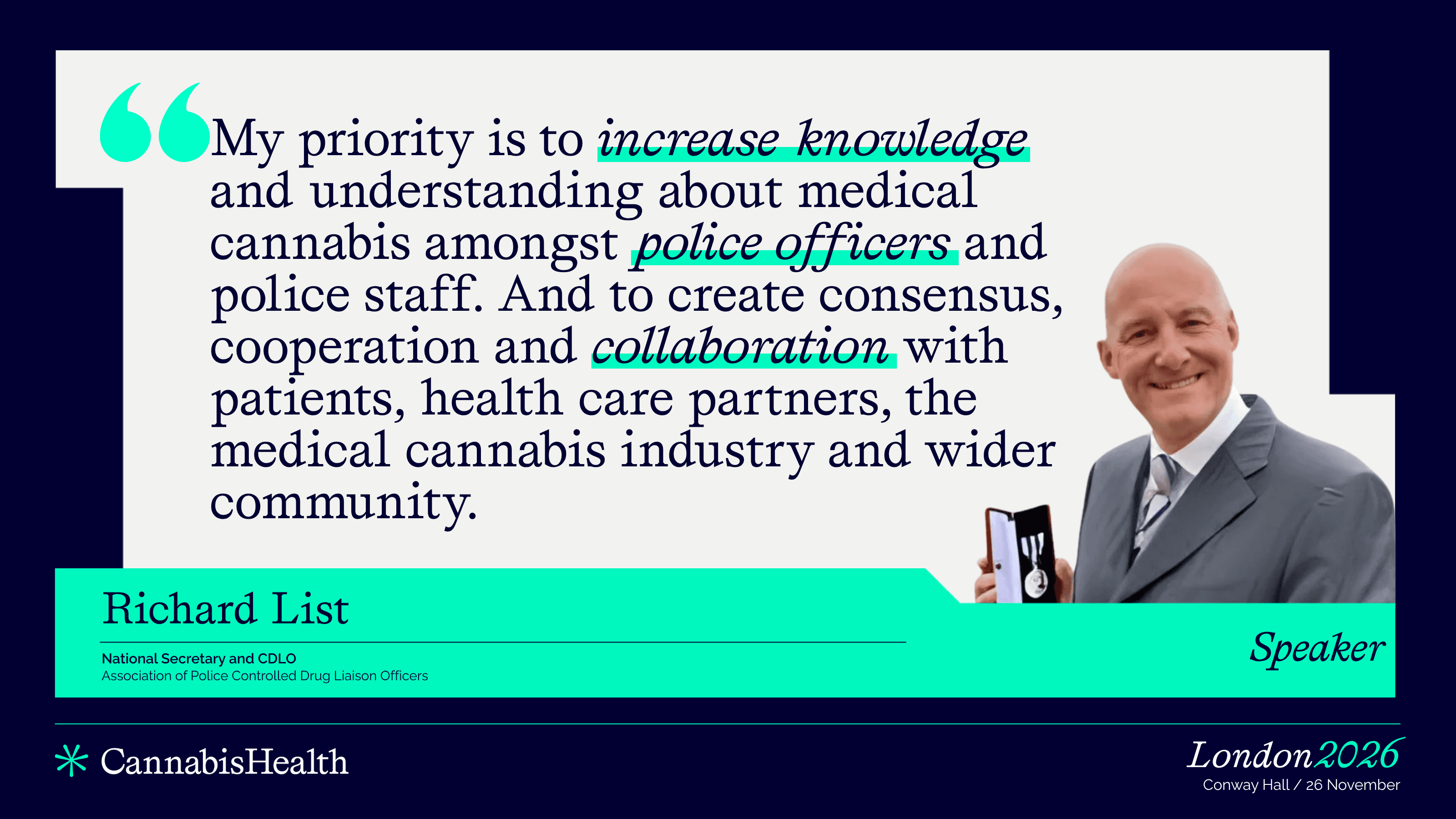
Senior police officials are working on more definitive guidelines around driving and medical cannabis ahead of a discussion at the Cannabis Health Symposium in London later this year.
The first national guidance for frontline officers was prepared by the Association of Police Controlled Drug Liaison Officers (APCDLO) and approved by the National Police Chiefs’ Council (NPCC) last year.
Former Detective Chief Superintendent and Controlled Drug Liaison Officer, Richard List QMP, said work is now underway to develop clearer guidance for police in relation to medical cannabis and driving, amid concerns over inconsistent approaches to patients and a lack of understanding among officers.
He played a key role in the development of the first guidelines, which highlighted the importance of frontline officers establishing a ‘patients first, suspects second’ mindset.
List, who will discuss this work at Conway Hall in London on 26 November, says driving has emerged as one of the most complex areas for police forces navigating the growing use of prescribed cannabis.
“The problems that are facing the police are the same problems that are facing the police in relation to medical cannabis, anyway,” he told Cannabis Health.
“There is a lack of knowledge, there is a lack of understanding, and as a result, there is a lack of acceptance of medical cannabis.”
Driving is a “complex” issue
Significant questions remain over how existing drug-driving legislation should be applied to medical cannabis patients.
Under Section 4 of the Road Traffic Act 1988, it is an offence to drive while unfit through drugs, where a person’s ability to drive properly is impaired.
Section 5A, meanwhile, created a separate offence of driving with the concentration of a specified controlled drug above a prescribed limit. For THC, this limit is set at 2µg per litre of blood.
A statutory medical defence may be available to patients taking prescribed medicines in accordance with the relevant directions, but List points out that this does not necessarily prevent a patient from being stopped, tested or entering the criminal justice process before that defence is considered.
For police officers, he says, the decision is complicated by concerns around road safety and the potential consequences of allowing someone to continue driving where there may be uncertainty over impairment.
While roadside drug tests can indicate the presence of cannabis, they do not themselves establish whether an individual is actually impaired.
“This is a complex, confusing, and vexed issue,” he said.
“There is undoubtedly debate within the police service about which is the right way to go forward.”
List has met with representatives from the NPCC Roads Policing Portfolio, and senior police figures from across the UK, to discuss these challenges and how to address them.
The next stage will involve preparing a briefing paper and obtaining specialist legal advice, but he hopes the “definitive guidance” will be ready “as soon as possible”.
Any guidelines will need to balance several competing risks, including unnecessary arrests of legitimate patients and the responsibility of police to protect road users where there are genuine concerns about impairment.
“There’s no quick fix,” he said.
“What we’ll try and find is the balance between the police, between public safety, road safety, and the needs of patients.”
The need for this is only becoming more important as the number of patients accessing medical cannabis prescriptions continues to grow.
“There’s huge confusion, and it’s only going to become a bigger challenge,” added List.
“Although it will take time, I’m happy that at least now we have a pathway.”
Bringing the debate to the Cannabis Health Symposium
List says he hopes to give delegates a clearer understanding of the difficulties police are currently attempting to resolve when he discusses these issues in more detail at the Cannabis Health Symposium in London on 26 November.
His session will explore the latest guidance for medical cannabis patients and police officers, helping clinicians, patients and healthcare providers better understand the practical implications of the law and how it is being applied across the UK.
Get the weekly briefing
A round-up of the latest science, regulation and developments across the UK and Europe — in your inbox every week.